
Blade & Bow 12-Year Solera Reserve: Is This the Key to Great Bourbon?
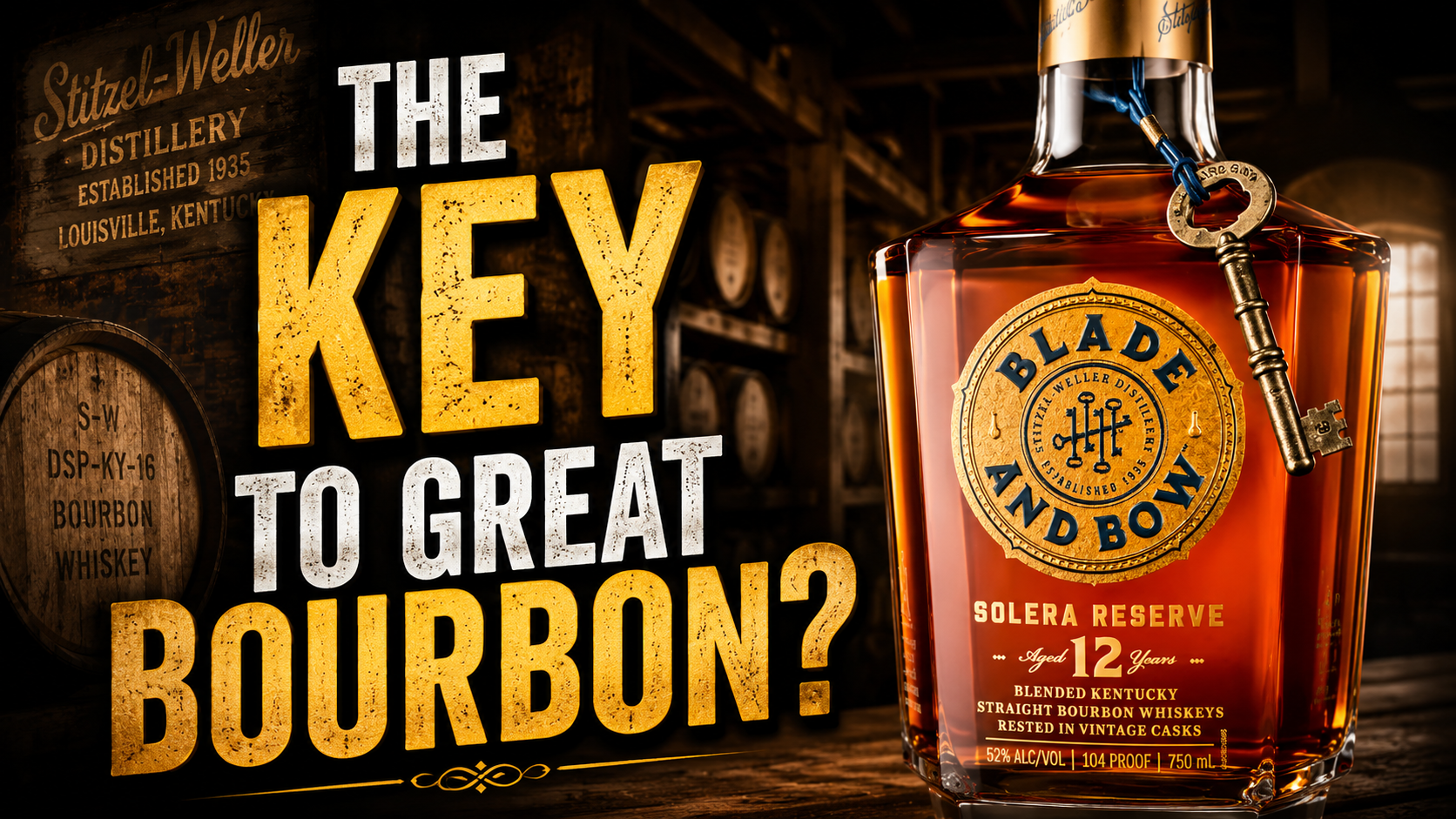
Blade & Bow 12-Year Solera Reserve
Blade & Bow 12-Year Solera Reserve: Is This the Key to Great Bourbon?
Some bottles show up with a decent age statement, a respectable proof, and maybe a fancy box.
Blade & Bow 12-Year-Old Solera Reserve shows up dragging nearly a century of bourbon history behind it.
This is a 12-year-old Kentucky bourbon tied to one of the most legendary names in American whiskey, finished through an unusual multi-vat Solera process, bottled at a healthy 104 proof, and wrapped in branding that leans hard into the mythology of the old Stitzel-Weller Distillery.
That is a lot for one little brass key to unlock.
So naturally, we had to pour it.
Before Blade & Bow, There Was Stitzel-Weller
You really cannot talk about Blade & Bow without talking about Stitzel-Weller Distillery.
The distillery opened in Louisville on Kentucky Derby Day in 1935, not long after Prohibition ended. Over the following decades, Stitzel-Weller became closely associated with some of the most famous names in wheated bourbon, including Old Fitzgerald, W.L. Weller, Rebel Yell, and the Van Winkle legacy.
That alone is enough to make serious bourbon drinkers start speaking in hushed tones.
The distillery eventually stopped producing whiskey in 1992, but the reputation of the liquid that came out of those old warehouses never disappeared. Vintage Stitzel-Weller bourbon became some of the most sought-after American whiskey in existence, and the property itself remained an important piece of bourbon history.
Today, Stitzel-Weller is owned by Diageo, and Blade & Bow exists as a tribute to that heritage. Diageo itself describes Blade & Bow as honoring the craftsmanship of the legendary distillery.
And yes, that little key hanging from the bottle matters.
What Does Blade & Bow Mean?
The name comes from the parts of an old-fashioned skeleton key.
The long shaft is the blade.
The part you hold is the bow.
Blade & Bow bottles carry one of five numbered keys, and collectors can hunt down the complete set. The five keys represent what the brand calls the Five Keys of Bourbon: grain, yeast, fermentation, distillation, and aging.
Is this clever marketing?
Absolutely.
Does it also look pretty damn cool hanging from the bottle?
Also absolutely.
But the more interesting part of this particular release is what happens to the bourbon before that key ever reaches the neck.
What Is Blade & Bow 12-Year-Old Solera Reserve?
Released in 2026, Blade & Bow 12-Year-Old Solera Reserve is intended to become a limited annual expression. It is built around 12-year-old Kentucky Straight Bourbon Whiskey and bottled at 104 proof, or 52% ABV. The suggested retail price at launch was $64.99 for a 750 mL bottle.
And right there, before we get fancy, those numbers get our attention.
Twelve years.
104 proof.
Sixty-five bucks.
In the current bourbon market, that’s an interesting proposition before you even start talking about Solera.
But then things get weird.
In a good way.
So What the Hell Is Solera?
Traditional Solera systems originated in the wine world, most famously with Spanish sherry.
Instead of completely emptying a vessel and starting over, only part of the mature liquid is removed. Younger liquid is then introduced and blended with what remains.
Repeat the process over time and you create a continuously evolving blend.
Think sourdough starter.
Or, if you’re B, think about a pot of chili that somehow survives for 40 years without violating several health codes.
The underlying idea is continuity.
Each generation carries something from the one before it.
Blade & Bow takes that concept and gives it a decidedly whiskey-driven twist.
For the 12-Year Solera Reserve, Diageo says the bourbon is influenced through vintage Cognac, Bordeaux, Moscatel, and Port vats. The different vessels are designed to bring separate flavor components into the final whiskey rather than simply burying the bourbon under one dominant finishing profile.
That’s what makes this release considerably more interesting than somebody simply dumping bourbon into a random wine barrel and calling it Tuesday.
Cognac, Bordeaux, Port and Moscatel Walk Into a Rickhouse…
Each of those influences theoretically brings something different.
The Port and Bordeaux components push toward darker fruit, structure, and tannin.
Cognac can contribute richer fruit and aromatic complexity.
Moscatel brings sweeter, brighter characteristics.
And underneath all of that is still a mature 12-year-old Kentucky bourbon.
That’s an ambitious combination.
It’s also potentially dangerous.
Because finished bourbon can go south in a hurry.
Too much wine influence and suddenly you’re wondering where the bourbon went. Too much oak from twelve years of aging and the entire thing can taste like someone soaked a Home Depot lumber aisle in grape juice.
Balance matters.
And that’s really the question hanging over this bottle.
What Should Blade & Bow 12-Year Taste Like?
The official profile leans heavily into mature fruit and dessert notes.
Expect aromas and flavors around red fruit, dried fig, currant, caramelized sugar, almond toffee, cocoa, dark cherry, oak spice, and underlying corn sweetness, with some wine-like tannin and acidity appearing through the finish.
On paper?
That sounds outstanding.
But bourbon isn’t graded on paper around here.
And neither is history.
The Stitzel-Weller Problem
Blade & Bow has something going for it that most bourbon brands would kill for:
Stitzel-Weller.
It is also potentially the brand’s biggest problem.
Put that name anywhere near a bourbon bottle and expectations immediately climb.
People remember Pappy Van Winkle.
Old Fitzgerald.
Weller.
Those legendary dusty bottles people now trade like pieces of fine art.
But buying Blade & Bow today does not mean you’ve discovered a secret bottle of 1960s Stitzel-Weller bourbon sitting unnoticed at your local ABC store.
Blade & Bow is a modern whiskey brand honoring that history.
That’s an important distinction.
When the original Blade & Bow launched in 2015, Diageo said the expression included some whiskey from old Stitzel-Weller stocks, alongside other bourbons.
But nostalgia doesn’t get a free pass.
Neither does a beautiful bottle.
Neither does twelve years.
And neither does a key.
The Question That Actually Matters
Strip everything else away and we’re left with a pretty intriguing whiskey:
12-year-old Kentucky straight bourbon.
104 proof.
A multi-vat Solera treatment involving Cognac, Bordeaux, Moscatel and Port.
$64.99 suggested retail at release.
At that point, we don’t really care whether Pappy himself rises from the grave and personally hands us the cork.
There’s only one question left.
Does it taste good?
That’s where the history lesson ends and Tortured Bourbon begins.
Because B and Heather are pouring Blade & Bow 12-Year Solera Reserve, picking apart the nose, palate and finish, arguing about whatever inevitably needs arguing about, and eventually putting it where every bourbon belongs:
Piddlin’
Bless Your Heart
That Dog Will Hunt
Hush Your Mouth
or
Cock of the Walk.
So is Blade & Bow 12-Year Solera Reserve really the key to great bourbon?
