
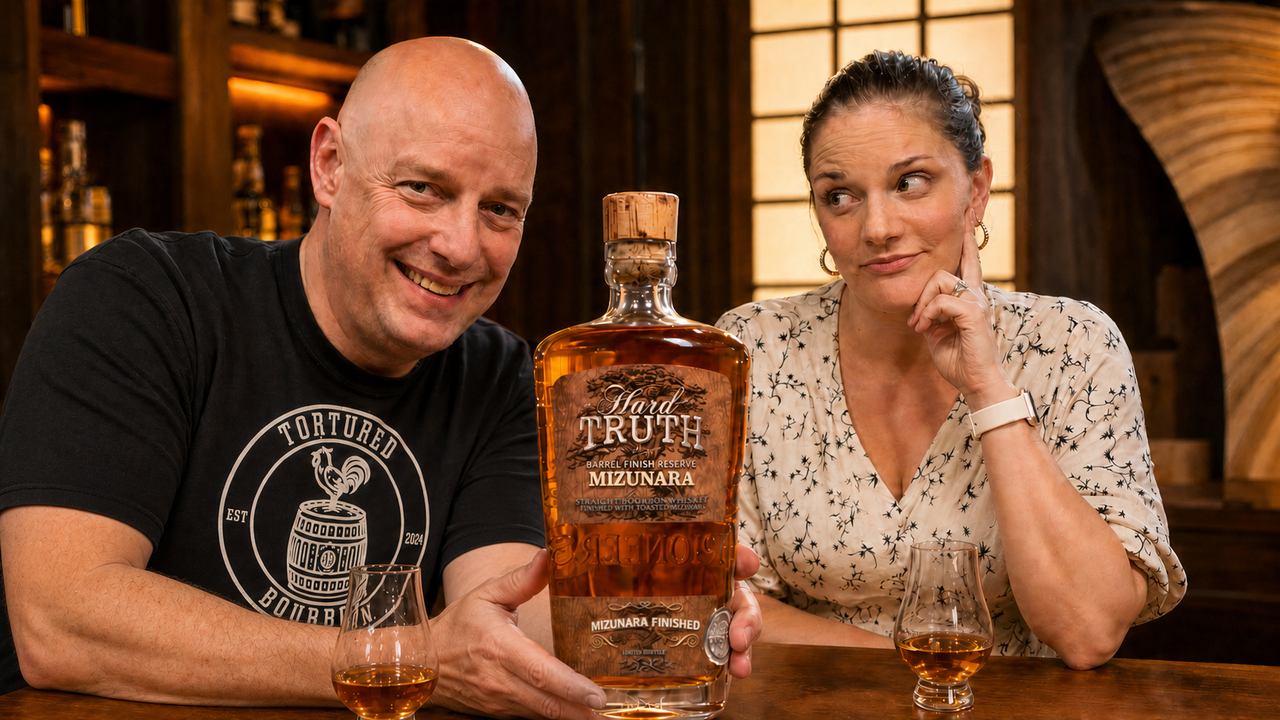
Hard Truth Mizunara Bourbon
Hard Truth Mizunara Finished Wheated Bourbon Review
What happens when you take a six-year-old wheated bourbon, bottle it at 116 proof and finish it in one of the most expensive and temperamental types of oak in the world?
According to Heather, you get “Japanese wood bourbon.”
She isn’t technically wrong.
In this episode of Tortured Bourbon, we taste Hard Truth Barrel Finish Reserve Mizunara Finished Wheated Bourbon. It’s a cask-strength, sweet-mash bourbon produced by Hard Truth Distilling Company and finished for several weeks in Japanese Mizunara oak.
That sounds impressive. It also sounds expensive.
Fortunately, those two things are not always the same.
[EMBED THE YOUTUBE EPISODE HERE]
What Is Hard Truth Mizunara Finished Wheated Bourbon?
Hard Truth begins this release with its BW-2 wheated bourbon. The mash bill contains:
69% corn
19% wheat
12% malted barley
No rye
The bourbon spends approximately six years aging in its original American oak barrels. Hard Truth then transfers it into Mizunara oak barrels for an additional eight to twelve weeks.
The finished whiskey is bottled at cask strength:
116 proof
58% alcohol by volume
Approximately six years old
Suggested retail price around $70 at the time of our episode
For a six-year, distillery-produced, cask-strength bourbon with a Mizunara finish, that price caught us by surprise.
Heather was briefly forced to reconsider her opening assumption that B had paid too much.
She recovered quickly.
What Is Mizunara Oak?
Mizunara is a species of oak native to East Asia. It is most famously associated with Japanese whisky, although American whiskey producers have increasingly experimented with Mizunara barrels and finishing staves.
The wood is unusual for several reasons.
Mizunara trees grow slowly and must mature for a long time before they can produce suitable barrel wood. The oak is also porous, difficult to cooper and prone to leaking.
In other words, it is expensive, temperamental and inconvenient.
Naturally, whiskey producers love it.
When Mizunara works well, it can contribute distinctive aromas and flavors commonly described as:
Sandalwood
Incense
Coconut
Baking spice
Aromatic wood
Temple-like or perfumed notes
“Incense” is an intriguing whiskey descriptor.
It is also why Heather became concerned that the bourbon might taste like a candle store.
What Is Wheated Bourbon?
Bourbon must be produced from a grain mixture containing at least 51% corn. After that requirement is met, distillers can use other grains to shape the whiskey’s flavor.
Many bourbon mash bills use rye as the primary secondary grain. Rye can contribute pepper, spice, herbs and a sharper flavor profile.
Wheated bourbon replaces that rye with wheat.
Wheat is generally associated with a softer, rounder profile. It can allow flavors such as caramel, vanilla, bread, fruit and oak sweetness to come forward without the assertive spice that rye can provide.
Maker’s Mark, Larceny and Weller are familiar examples of wheated bourbon, although each uses a different recipe and production process.
Hard Truth’s BW-2 mash bill uses 19% wheat and no rye. That softer foundation is the whiskey the distillery selected for its Mizunara finishing experiment.
Hard Truth Actually Distilled This Bourbon
Hard Truth Distilling Company is located in Nashville.
Tennessee?
No. Indiana.
Apparently, there is a Nashville, Indiana. We do not believe Nashville, Tennessee was consulted.
The location matters because Indiana is strongly associated with sourced whiskey. Many brands purchase whiskey distilled in Indiana, bottle it under another name and tell a creative story about where it came from.
That is not what happened here.
Hard Truth distilled this bourbon on its own equipment. The company began producing whiskey in 2018, and bourbon was the first whiskey it placed into barrels.
This is Hard Truth’s mash bill, fermentation, distillation and maturation—not a sourced bourbon with a new label and an expensive finishing barrel.
Hard Truth’s Sweet-Mash Process
Hard Truth frequently emphasizes its use of sweet-mash whiskey production.
Most bourbon drinkers are more familiar with the term “sour mash.” Despite the name, sour-mash whiskey is not supposed to taste sour.
In a traditional sour-mash process, some of the liquid remaining from a previous distillation—usually called backset—is introduced into the next mash. That backset helps control acidity and maintain consistency from one fermentation to the next.
Sweet mash takes a different approach.
Every batch begins fresh, without backset from the previous distillation. Hard Truth says this allows the distillery to emphasize flavors coming directly from the grain.
The process can require greater control because the distiller is not using acidic backset to help stabilize the next fermentation.
After going through all that additional trouble, Hard Truth placed the bourbon into expensive Japanese oak.
These people apparently needed another hobby.
Why Finish Wheated Bourbon in Mizunara?
Hard Truth did not simply choose Mizunara because it sounded rare.
Master Distiller Bryan Smith and the Hard Truth team conducted bench trials that paired different mash bills with different finishing woods. The distillery specifically selected its BW-2 wheated bourbon for Mizunara.
That pairing makes sense in theory.
A wheated bourbon can offer a softer canvas than a rye-forward recipe. Mizunara may then introduce aromatic wood, coconut, spice and incense-like characteristics without fighting against heavy rye spice.
The finishing period lasted only eight to twelve weeks, but this was already mature bourbon. The secondary barrel was not intended to disguise young whiskey. It was supposed to add another layer.
The important question is whether that layer can actually be found in the glass.
Does Rare Wood Make Better Bourbon?
Mizunara is rare. It is expensive. It has an interesting history, and putting the word on a label immediately makes a whiskey sound more exotic.
None of that guarantees a good bourbon.
A finishing barrel should complement the underlying whiskey. If the secondary oak overwhelms the bourbon, the result can become bitter, dry or aggressively woody. If it contributes too little, the finish becomes an expensive marketing story.
That is why we taste whiskey before deciding what we think about it.
A limited release, cask-strength proof and rare finishing barrel all sound impressive. Eventually, however, somebody has to drink the thing.
Preferably us.
We suffer through bourbon so you don’t have to.
The Tortured Bourbon Ranking
Every bottle we review receives a place on our completely scientific and internationally respected Tortured Bourbon ranking:
Piddlin’
Bless Your Heart
That Dog Will Hunt
Hush Your Mouth
Cock of the Walk
Watch the full episode to hear what Heather and B found in the glass—and whether Hard Truth Mizunara Finished Wheated Bourbon justified its price, proof and Japanese wood.
Would You Buy It?
Would you spend around $70 on a six-year, 116-proof wheated bourbon finished in Mizunara oak?
Have you tried this Hard Truth release or another Mizunara-finished whiskey? Did you find sandalwood, coconut and spice—or did it taste like somebody wandered into a candle store?
Let us know where you would place it on the Tortured Bourbon ranking.
Subscribe to Tortured Bourbon for more bourbon reviews, whiskey education, questionable purchases and Heather reminding B that expensive bourbon is not necessarily good bourbon.
We suffer through bourbon so you don’t have to.
