
History of Finishing: How Secondary Cask Maturation Transformed American Whiskey
For decades, secondary finishing was practically sacrilege in American whiskey. While Scotch distillers routinely rested their single malts in sherry, port, or wine casks, Kentucky bourbon purists viewed the practice as unnecessary—and legally tricky. Under Federal TTB guidelines, straight bourbon must mature exclusively in new charred oak containers. Transferring that liquid into a secondary barrel removes its "straight bourbon" label designation, reclassifying it as a "Distilled Spirit Specialty" unless specific front-label phrasing is used.
Today, secondary finishes—ranging from Madeira, Cognac, and rum to toasted staves and heavy-char barrels—are standard offerings across major rickhouses and craft distilleries alike. The path from taboo experiment to mainstream staple came down to early pioneers and a landmark 2010 release.
Early Experiments: The Forgotten Firsts
While single malt Scotch producers like The Balvenie pioneered commercial cask finishing in the early 1980s, a few American distillers quietly tested the waters late in the 20th century.
The 1990s One-Offs: Legacy producers like Jim Beam experimented with wine-barrel-finished whiskies in the late 1990s (such as Jim Beam Distiller's Masterpiece). These releases were treated as temporary novelty items rather than core portfolio offerings.
Regulatory Hurdles: Because producers could not legally call secondary-cask whiskies "Straight Bourbon" on its own, these releases required detailed front-label phrasing—such as "Straight Bourbon Whiskey Finished in Port Wine Barrels"—to clear TTB approval.
Who Brought Finished Bourbon Mainstream?
While experimental batches existed earlier, Lincoln Henderson and Angel’s Envy brought finished bourbon into the modern mainstream.
After retiring as Master Distiller at Brown-Forman—where he helped create Woodford Reserve and Gentleman Jack—Lincoln Henderson partnered with his son, Wes Henderson, to launch Angel’s Envy in 2010. Their flagship release was a Kentucky straight bourbon finished in ruby port wine casks for 3 to 6 months.
Industry Skepticism: Bourbon purists initially pushed back, viewing port finishing as an unnecessary masking agent for sub-par whiskey.
Consumer Demand: The rich dried fruit, chocolate, and amplified oak notes resonated strongly with both seasoned dark spirit enthusiasts and newer drinkers.
Category Validation: Angel’s Envy proved that secondary finishing enhanced whiskey complexity without sacrificing the core bourbon profile. Its massive commercial success forced heritage distilleries to re-evaluate secondary barrel maturation.
Secondary Finishing Categories Today
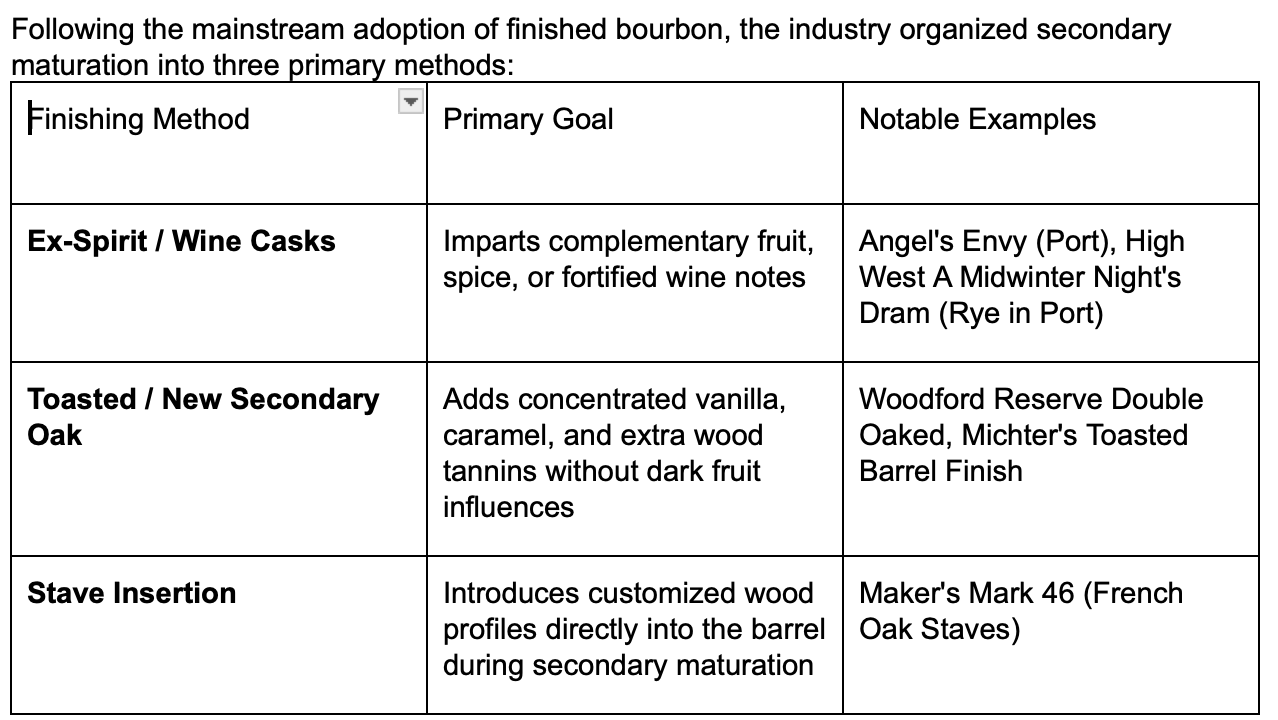
(Chart)
What began as a controversial breach of tradition has become one of the dynamic drivers of innovation in modern American whiskey production. Now that we're seeing the bourbon market slow down, will we continue to see finishing remain popular?
Recently, on Bourbon Real Talk, Randy shared that he can now source Kentucky distillate via barrel brokers that have aged 8 years, keep his average profit margins, and sell that barrel for $70 a bottle. With that quality available to NDPs, will the need for finishing younger whiskey continue?
As y'all may know, Double Oaked bourbon is my favorite sub-category to enjoy. You may be wondering why am I asking these questions and the answer is that I enjoy exploring different takes on my favorite bourbons. I enjoy the creativity that producers have and welcome the experience of trying new expressions. My hope would be the lower cost of entry would continue to encourage more risks to see different rewards.
Regardless of what happens, I will continue to sip and enjoy whatever this amazing hobby brings to my glen and I hope y'all continue this journey with us. Cheers y'all!
