
Can We Find the King? King of Kentucky vs Old Forester Blind Bourbon Tasting
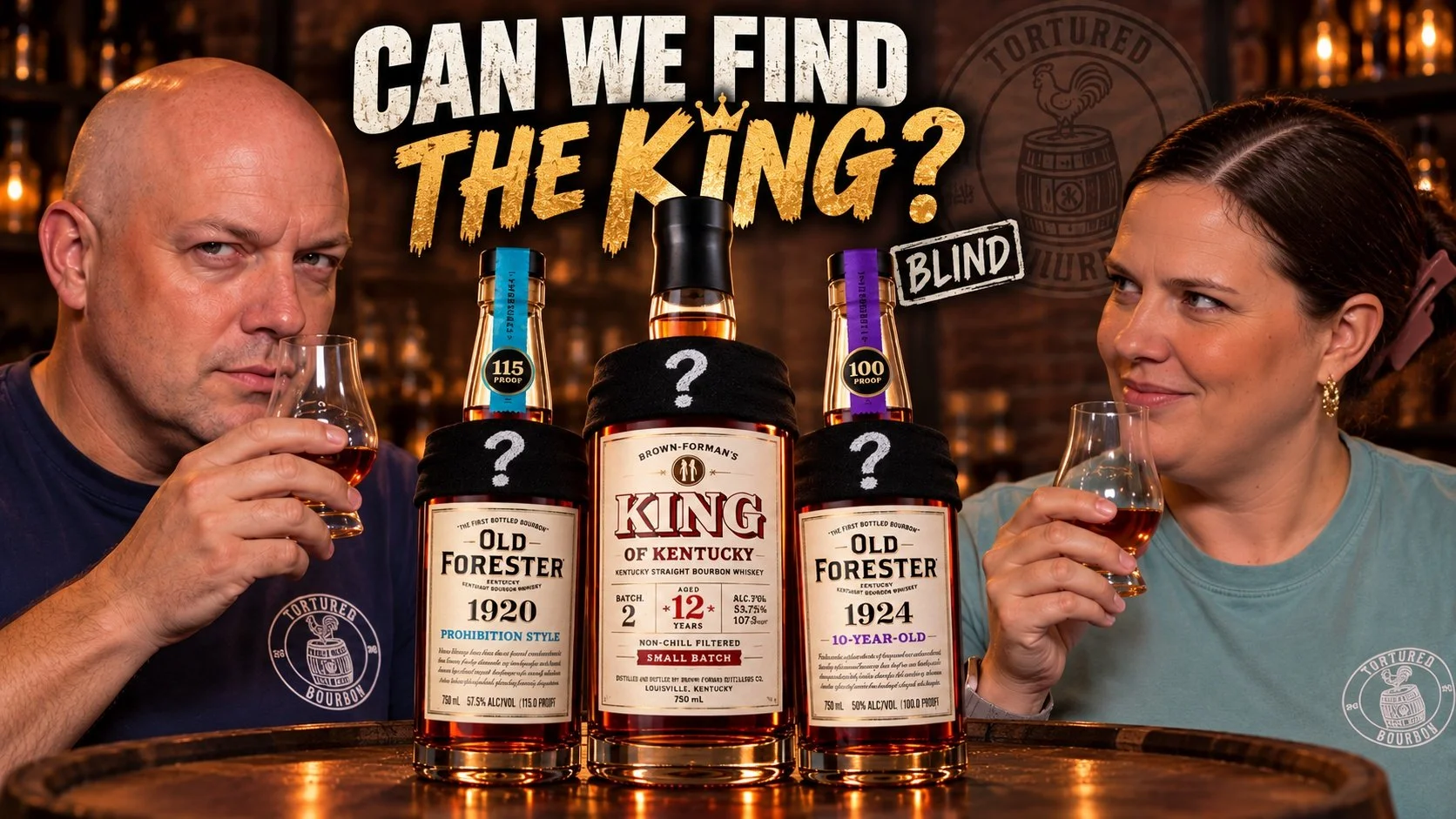
There are some bourbon bottles that arrive at the table carrying a little more baggage than others.
King of Kentucky carries an entire royal procession.
It’s rare. It’s expensive. It’s allocated. Bourbon drinkers hunt it, trade stories about finding it, and generally treat the bottle with the kind of reverence normally reserved for national monuments and Willie Nelson.
But take away the label?
Now things get interesting.
For this episode of Tortured Bourbon, B and Heather put King of Kentucky Small Batch Batch 2 into a blind bourbon tasting against two bottles from the same Brown-Forman family: Old Forester 1920 Prohibition Style and Old Forester 1924 10-Year-Old.
Three Kentucky bourbons.
Three very different reputations.
No labels.
And one question:
Can we actually find the King?
King of Kentucky Enters the Blind
The centerpiece of this bourbon tasting is King of Kentucky Small Batch Batch 2, a 12-year age-stated Kentucky bourbon bottled at 107.5 proof.
King of Kentucky occupies an entirely different part of the bourbon world from the bottles most people see sitting on an ABC store shelf.
It’s the kind of bourbon people line up for.
It’s the kind of bourbon collectors chase.
And it's the kind of bourbon where simply seeing the bottle can influence what you think you're tasting before the whiskey ever hits your tongue.
That makes it almost perfect for a blind bourbon tasting.
If King of Kentucky really is special, we should be able to recognize something different about it without knowing which glass contains it.
Right?
Well...
That’s the theory.
Heather has entered the chat.
Old Forester 1920 Prohibition Style
First up as competition is Old Forester 1920 Prohibition Style.
At 115 proof, Old Forester 1920 has developed a loyal following among bourbon drinkers who like darker flavors, higher proof and a whiskey that doesn't exactly whisper when it enters the room.
It’s part of the Old Forester Whiskey Row Series and represents the style of whiskey associated with the Prohibition era, when Old Forester remained one of the brands legally permitted to bottle whiskey for medicinal purposes.
But history lesson aside, there’s another reason we wanted Old Forester 1920 in this bourbon tasting:
It can be really damn good.
And unlike King of Kentucky, you don't normally need a treasure map, three buddies working different liquor stores and divine intervention to find a bottle.
That creates the first interesting question of the blind:
Can a readily available Old Forester bourbon hang with King of Kentucky when nobody can see the labels?
Old Forester 1924 10-Year-Old
Then there is Old Forester 1924.
This one makes the comparison even more interesting.
Old Forester 1924 carries a 10-year age statement and comes in at 100 proof. It also uses a mash bill different from the standard Old Forester recipe, giving us another mature Kentucky bourbon with enough distinction to potentially confuse the hell out of both of us.
Which, frankly, isn't difficult.
B: “I know which one is the King.”
Heather: “You said that about the last one.”
B: “I have revised my position.”
Heather: “That's a fancy way of saying you were wrong.”
And there, ladies and gentlemen, is basically Tortured Bourbon.
Why Blind Bourbon Tasting Matters
Blind tasting bourbon is one of the fastest ways to discover just how much the bottle influences the person drinking it.
Price matters.
Age statements matter.
Scarcity matters.
The story matters.
And if somebody sets King of Kentucky in front of you and tells you exactly what you're drinking, it is almost impossible not to approach the glass expecting something exceptional.
That doesn’t mean expensive or rare bourbon isn't exceptional.
Sometimes it absolutely is.
The point of a blind bourbon tasting is simply to remove as many of those expectations as possible.
Now the whiskey has to do the talking.
For this tasting we have:
King of Kentucky Small Batch Batch 2
12 Years Old
107.5 Proof
Old Forester 1920 Prohibition Style
115 Proof
Old Forester 1924
10 Years Old
100 Proof
All three are Kentucky bourbon.
All three come from the Brown-Forman universe.
But their prices, availability, age, proof and reputation couldn't be more different.
Can We Actually Find the King?
That's where this bourbon tasting gets fun.
We're not simply ranking three bourbons.
We're trying to identify a bottle that enters the tasting carrying an enormous reputation.
Does King of Kentucky have a maturity that immediately separates it from Old Forester?
Does the proof of Old Forester 1920 make it seem older or more powerful than it really is?
Can the 10-year age statement on Old Forester 1924 throw us off?
And perhaps the most dangerous question of all:
What happens if one of the Old Forester bottles tastes better?
Because bourbon doesn't care what you paid for it.
It doesn't care how many bottles were released.
And it definitely doesn't care how proud B was when he acquired it.
Heather probably cares even less.
The Reveal
We aren't spoiling the final ranking here.
You need to watch the episode for that.
Because half the fun of a blind bourbon tasting is watching two people become increasingly confident in opinions that may collapse spectacularly once the bottles are revealed.
The important part is that King of Kentucky, Old Forester 1920 and Old Forester 1924 all had to compete on exactly the same terms.
No prestige.
No price tags.
No allocation status.
Just Kentucky bourbon in a glass.
And sometimes that's the best way to remember why we started drinking this stuff in the first place.
Not because the internet told us what bottle we're supposed to love.
Because we tasted it.
Watch the complete King of Kentucky blind bourbon tasting on Tortured Bourbon and see whether B and Heather can actually identify the King.
And if you've tried King of Kentucky, Old Forester 1920 or Old Forester 1924, tell us which one you would pick blind.
Because around here, the bottle gets a vote.
But the bourbon gets the final word.
We suffer through bourbon so you don't have to.
