
Featured image filename
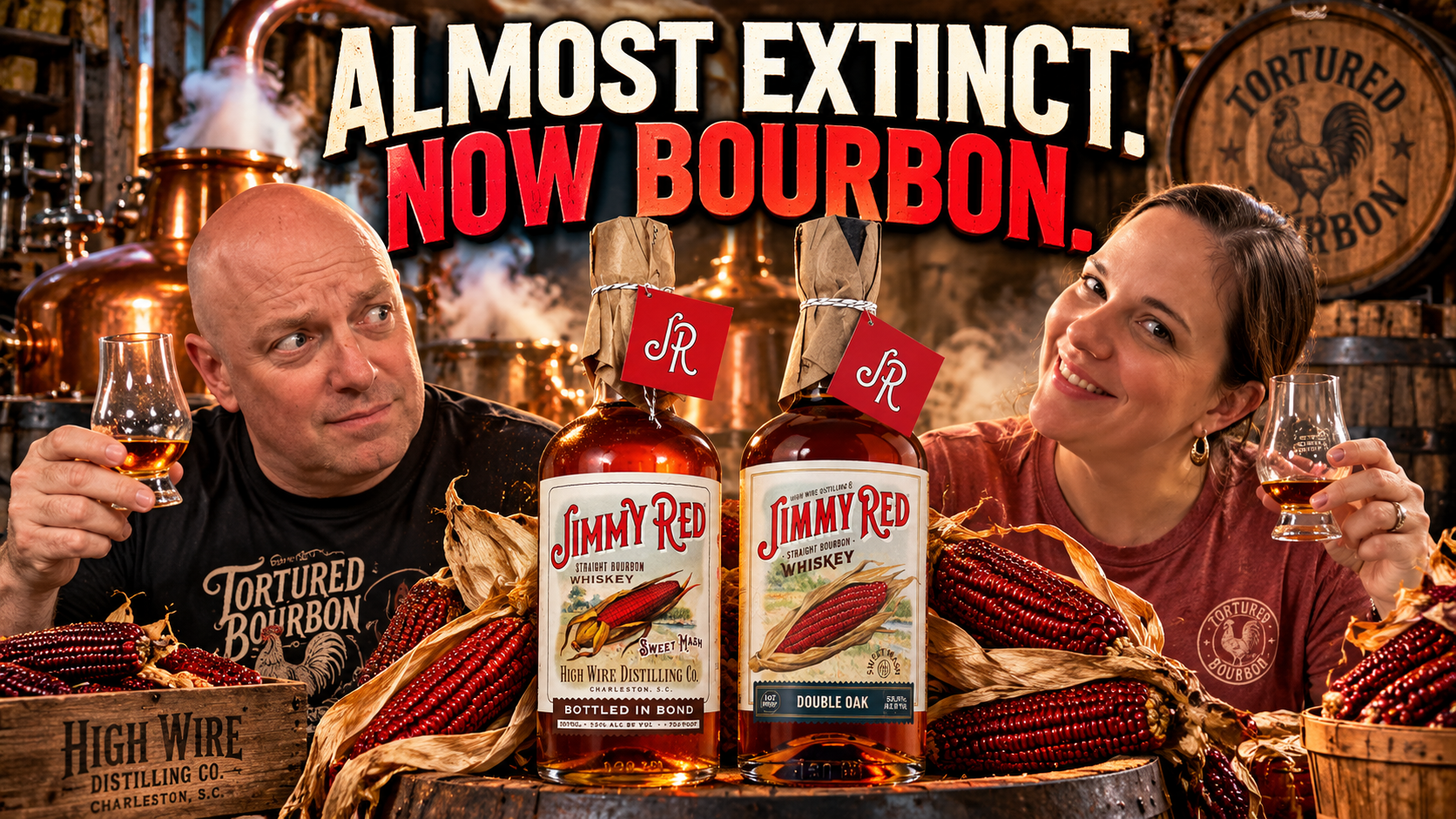
jimmy red bottled-in-bond double oak tortured bourbon.
Two South Carolina bourbons. One remarkable comeback story. And two people who can turn a glass of whiskey into a spirited disagreement.
Some bourbon stories begin with a famous family name. This one begins with corn that nearly disappeared.
In this episode of Tortured Bourbon, B and Heather explore Jimmy Red Bottled-in-Bond and Jimmy Red Double Oak, two expressions from High Wire Distilling in Charleston, South Carolina.
One comes in at 100 proof. The other turns things up to 107. Both give us a reason to talk about what happens before whiskey ever reaches a barrel.
Which means B has an excuse to discuss agriculture.
Heather was probably hoping we could just drink.
High Wire Distilling: Charleston Bourbon with an Agricultural Story
Founded in 2013 by Scott Blackwell and Ann Marshall, High Wire Distilling builds its spirits around heritage grains and the flavors they bring to the glass. The distillery produces its spirits in downtown Charleston, with an approach shaped by farming, food, and an interest in preserving regional ingredients. High Wire’s story
That makes Jimmy Red an especially fitting signature bourbon.
Bourbon conversations often revolve around age, proof, and barrel selection. Those things matter. But High Wire gives us another question to consider: What difference can the corn itself make?
For whiskey drinkers curious about South Carolina bourbon, Jimmy Red offers a starting point rooted in the Lowcountry.
For B, it offers enough material to turn a tasting into a lecture.
We’re counting on Heather to keep things moving.
What Is Jimmy Red Corn—and Why Did It Almost Disappear?
Jimmy Red is a red-hued corn variety associated with James Island near Charleston. High Wire describes it as a traditional moonshiner’s corn that dwindled to just two remaining cobs after the death of its last known grower.
Its recovery involved seed preservation and collaboration. In 2014, Glenn Roberts of Anson Mills provided High Wire with seed for a 2.5-acre planting in partnership with Clemson University. That harvest supplied the corn for the distillery’s first two batches of Jimmy Red bourbon. The Jimmy Red revival
That is the story behind our episode’s hook:
Almost extinct. Now bourbon.
The corn nearly vanished. Today, its name appears on bottles that invite whiskey drinkers to think a little differently about grain.
Somebody saved two ears of corn, and eventually we got a bourbon episode out of it. That is an impressive return on gardening.
Jimmy Red Bottled-in-Bond Bourbon: The 100-Proof Contender
Jimmy Red Bottled-in-Bond is bottled at 100 proof, or 50% ABV, and High Wire specifies a minimum age of four years.
The distillery’s published tasting notes include tart cherry, dark chocolate, and leather, with coffee, baking spice, vanilla, and cinnamon also in the description. Those are the producer’s notes—a useful reference for the tasting, rather than a substitute for what B and Heather find in their glasses. Jimmy Red Bottled-in-Bond details
For this comparison, the interesting questions are about balance:
How do fruit, sweetness, spice, and oak come together?
Does the texture feel light, rich, or somewhere between?
Does the finish invite another sip?
How does it stand up beside the higher-proof Double Oak?
A list of tasting notes can get us started. It cannot settle an argument at Casa de Rooster.
Jimmy Red Double Oak Bourbon: The 107-Proof Contender
High Wire lists Jimmy Red Double Oak at 107 proof, or 53.5% ABV. That puts it seven proof points above the Bottled-in-Bond expression. High Wire’s spirits menu
For anyone searching for Jimmy Red double-barreled bourbon, Double Oak is the expression discussed here. Whisky Advocate describes its production as finishing High Wire’s Jimmy Red corn bourbon in new oak for an additional 14 months. Jimmy Red Double Oak production details
That additional barrel exposure gives the comparison another dimension: how does more oak influence interact with the whiskey’s underlying character?
The questions become especially interesting when tasting the two side by side. Does the Double Oak offer more satisfying depth? Does the wood complement the grain? Does the extra proof add presence or simply more heat?
“More barrel” sounds like an easy selling point.
Whether it means “better bourbon” is something the glass has to answer.
Why These Bourbons Make an Interesting Side-by-Side Tasting
Jimmy Red Bottled-in-Bond and Double Oak bring together two appealing whiskey subjects: heritage grain and maturation.
Their shared producer gives the tasting a common point of reference, while the different expressions invite discussion about proof, oak, and balance. It is a chance to explore Charleston bourbon through more than a single bottle.
It also raises a question that applies to plenty of whiskey purchases:
Are you choosing the bottle with the most impressive description, or the one you most enjoy drinking?
A compelling origin story earns our attention. The pour still has to earn its place on the shelf.
Watch the Tortured Bourbon Jimmy Red Episode
Join B and Heather for Jimmy Red Bottled-in-Bond vs. Double Oak, the story of High Wire Distilling, and a bourbon conversation that begins with endangered corn and may end with someone questioning the other person’s palate.
Watch the episode, then tell us which expression you would reach for first: 100-proof Bottled-in-Bond or 107-proof Double Oak?
And if you have tasted both, we want your pick—and your reasons.
Tortured Bourbon: We suffer through bourbon so you don’t have to.
Jimmy Red Bourbon FAQs
Who makes Jimmy Red bourbon?
Jimmy Red bourbon is produced by High Wire Distilling in Charleston, South Carolina.
What is the difference between Jimmy Red Bottled-in-Bond and Double Oak?
The Bottled-in-Bond expression is bottled at 100 proof and aged at least four years. Double Oak is bottled at 107 proof and receives additional maturation in new oak barrels.
Is Jimmy Red Double Oak the double-barreled expression?
Yes. Double Oak is the name High Wire uses for the expression discussed here, which undergoes an additional period in new oak.
What does Jimmy Red Bottled-in-Bond taste like?
High Wire’s published notes feature tart cherry, dark chocolate, leather, coffee, baking spice, vanilla, and cinnamon. Individual impressions can differ; watch the episode for B and Heather’s reactions.
Did Jimmy Red corn really almost go extinct?
According to High Wire’s account, the variety dwindled to two remaining cobs before preservation and cultivation efforts helped restore it.
Where is High Wire Distilling?
High Wire Distilling is located at 311 Huger Street in Charleston, South Carolina. Visit the official High Wire website for current visitor information.
