
Battle of Knob Creek: 12 Year 100 Proof vs. 12 Year Cask Strength
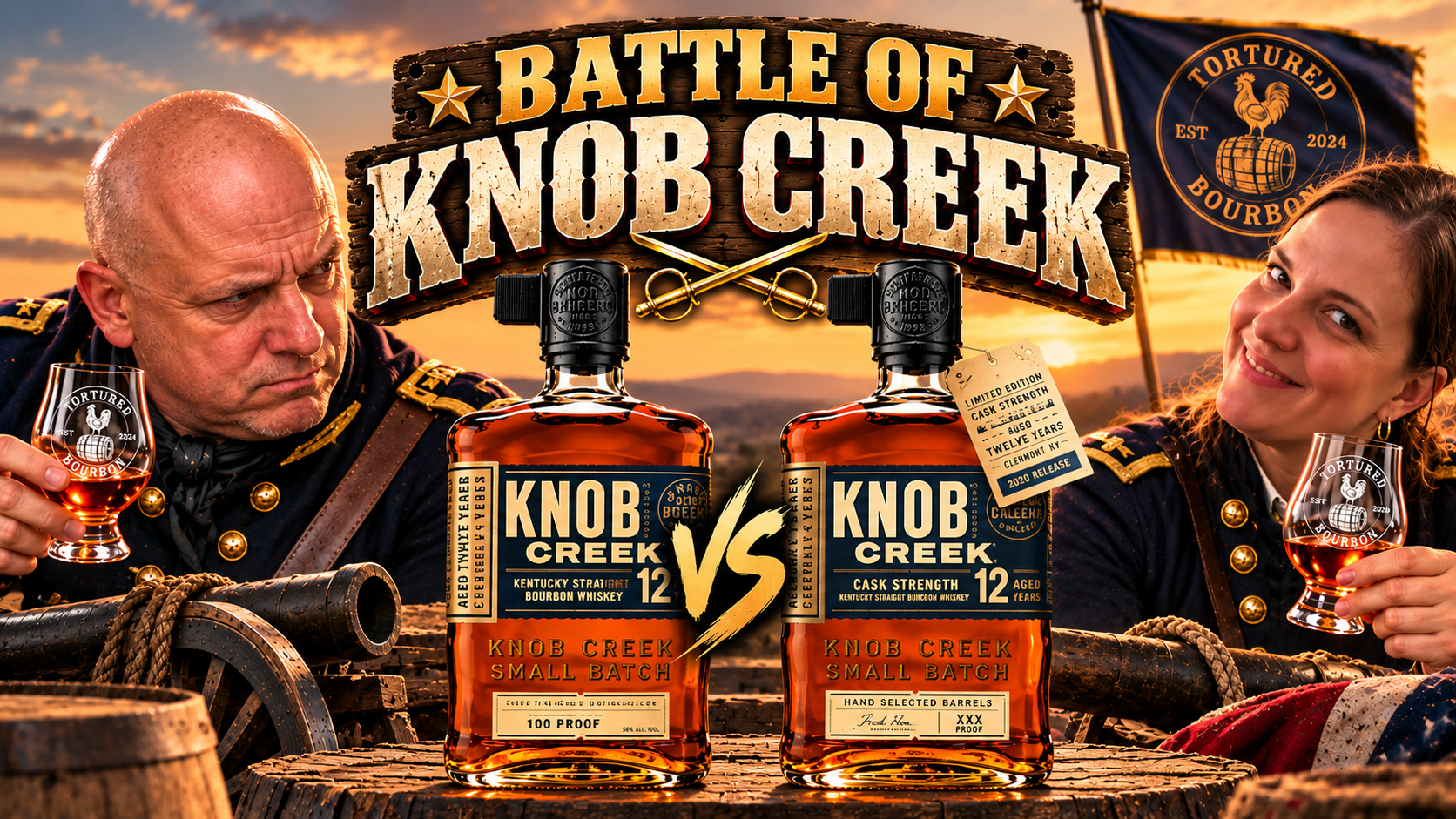
Knob Creek Cask Strength
There are complicated bourbon comparisons.
This is not one of them.
On one side of the table we have Knob Creek 12 Year Kentucky Straight Bourbon Whiskey, aged twelve years and bottled at a very respectable 100 proof.
On the other side we have the new Knob Creek 12 Year Cask Strength, also aged twelve years — except this one walks onto the battlefield at 121.2 proof.
Same age statement.
Same Knob Creek name.
Same basic bourbon lineage.
A 21.2-proof difference.
So naturally B and Heather decided the only reasonable way to settle this was war.
Welcome to the Battle of Knob Creek.
Knob Creek 12 Year Is Not Exactly the Underdog
Let's establish something before the cannons start firing.
Regular Knob Creek 12 Year is already serious bourbon.
This isn't a 90-proof shelf bottle being sacrificed to make the new limited release look impressive. Knob Creek bottles its standard 12 Year at 100 proof, and the brand describes it as a full-flavored, mature bourbon with bold spice, leathered fruit, vanilla and caramelized wood.
The official aroma profile includes heavy toffee, char, matured tobacco, toasted coconut and dark chocolate, followed by a warm finish carrying smoky char and lingering heat. Knob creek
In other words:
The 100-proof bottle came armed.
And that's what makes this comparison interesting.
If Knob Creek 12 were thin or delicate, we'd already know how this fight ends. Throw another 21 proof points at it, crank up the concentration and call it a day.
But Knob Creek 12 already has weight.
It already has oak.
It already has proof.
So the new Cask Strength release actually has to prove something.
Enter Knob Creek 12 Year Cask Strength
In September 2026, the James B. Beam Distilling Co. released Knob Creek 12 Year Old Cask Strength, a limited-edition Kentucky straight bourbon bottled at 121.2 proof — 60.6% ABV. Suntory Global Spirits
This isn't simply regular Knob Creek 12 with a bigger number slapped on the label.
According to the distillery, the bourbon was matured for twelve years in charred American white oak barrels and hand-selected from just 10 distinct lots in Knob Creek's Clermont, Kentucky rickhouses before being batched and bottled at cask strength. The suggested retail price is $89.99 for a 750 mL bottle. Suntory Global Spirits
And at 121.2 proof, the barrel isn't exactly whispering.
It's kicking the door in.
Knob Creek lists the aroma as caramel, char and dried apple, with butterscotch, dried apple and seasoned oak on the palate. The finish brings caramel and subtle cinnamon. Knob creek
That all sounds lovely.
But the bottle copy doesn't get to vote.
Heather does.
Which has historically been a problem for bottle copy.
100 Proof vs. 121.2 Proof
This is the heart of the episode.
Both bottles carry a 12-year age statement, but proof changes the experience dramatically.
At 100 proof, standard Knob Creek 12 already sits well above the proof of many mainstream bourbons.
The Cask Strength takes that same mature-bourbon proposition and pushes it to 121.2 proof.
So what are we actually gaining?
More caramel?
More oak?
More viscosity?
More spice?
A longer finish?
Or just more ethanol punching B in the face while Heather calmly says, “I don't know, I think the other one tastes better.”
Because that is entirely possible.
Higher proof does not automatically equal better bourbon.
Sometimes additional proof exposes more flavor.
Sometimes it makes an already oak-forward older whiskey feel hotter, drier and more aggressive.
And sometimes the lower-proof version turns out to be the better drinking experience because the distillery already found the sweet spot.
That's the battle.
Does Cask Strength Make Knob Creek Better?
Bourbon enthusiasts have developed a slight tendency to treat the words CASK STRENGTH and BARREL PROOF as sacred scripture.
We understand.
We're part of the problem.
There is something appealing about getting bourbon closer to the strength at which it lived in the barrel. Less dilution. More concentration. More of whatever twelve years in Kentucky oak managed to create.
But “more” and “better” are not synonyms.
That's particularly important with a 12-year bourbon.
Twelve years brings maturity, but it also brings a lot of wood.
And when you bottle that whiskey at 121.2 proof, you're turning the volume up on everything.
The caramel gets louder.
The spice gets louder.
The oak gets louder.
And occasionally the bourbon starts yelling.
Meanwhile, regular Knob Creek 12 has been sitting there quietly at 100 proof wondering why everyone suddenly thinks it needs fixing.
The Battle of Knob Creek
So we lined them up.
Knob Creek 12 Year
Age: 12 Years
Proof: 100
Style: Kentucky Straight Bourbon Whiskey
Knob Creek 12 Year Cask Strength
Age: 12 Years
Proof: 121.2
ABV: 60.6%
Style: Limited-Edition Kentucky Straight Bourbon Whiskey
Same age.
Same battlefield.
Very different artillery.
And B and Heather work through both bottles the way we always do — nose, palate, finish, overall experience and the inevitable disagreement over something one of us insists is obvious.
Because apparently two adults cannot simply drink good bourbon and say:
“That was nice.”
There must be conflict.
There must be rankings.
There must apparently be cavalry uniforms.
What Does Knob Creek 12 Taste Like?
The standard 12 Year brings exactly the kind of mature Beam profile you'd expect.
There's char.
There's caramelized oak.
There is sweetness underneath the maturity, along with dark chocolate, tobacco and toasted characteristics in the official profile. Knob creek
The interesting question is how much of that survives — or changes — when we move to cask strength.
Does the extra proof reveal flavors that feel muted at 100?
Does the fruit get bigger?
Does the butterscotch become richer?
Does the additional intensity make the oak more dominant?
Those differences matter much more to us than simply deciding which bottle contains more alcohol.
Is Knob Creek 12 Year Cask Strength Worth It?
This may be the bigger question for bourbon drinkers.
The new Cask Strength release carries a suggested retail price of $89.99, which is surprisingly approachable territory for a limited 12-year cask-strength bourbon in today's market. Suntory Global Spirits
But value doesn't exist in a vacuum.
If you already own Knob Creek 12, do you need the Cask Strength?
If you walk into a store and somehow see both bottles sitting there, which one should you grab?
If the Cask Strength gives you essentially the same experience with more heat, the answer becomes pretty easy.
But if those extra proof points turn the bourbon into something deeper, richer and dramatically more expressive?
Now we've got a problem.
A delicious, bourbon-related problem.
Those are generally the problems we prefer.
The 21.2-Proof Question
Strip away the uniforms, cannons and our unnecessarily dramatic thumbnail, and this episode really comes down to one question:
What are those extra 21.2 proof points buying you?
That's it.
Both bourbons are twelve years old.
Both come from Knob Creek.
One is already bottled at a sturdy 100 proof.
The other arrives at 121.2.
So we're not asking whether the Cask Strength is stronger.
We own calculators.
We're asking whether it's better.
Better aroma.
Better flavor.
Better finish.
Better balance.
And ultimately:
Which bottle would we rather drink?
Because bourbon isn't a math contest.
Nobody has ever sat down after dinner and said:
“Boy, that whiskey wasn't particularly enjoyable, but thank God the proof was enormous.”
At least nobody we'd invite back.
Which Knob Creek 12 Year Wins?
We're not spoiling the ending here.
Does the limited edition dominate?
Does the standard bottle hold the line?
Does Heather side with balance?
Does B immediately become hypnotized by the words “cask strength”?
We make no promises.
Except one.
Somebody is probably going to disagree.
Welcome to the Battle of Knob Creek.
We suffer through bourbon so you don't have to.
