
3 Old Forester Single Barrels: Does the Warehouse Floor Really Matter?
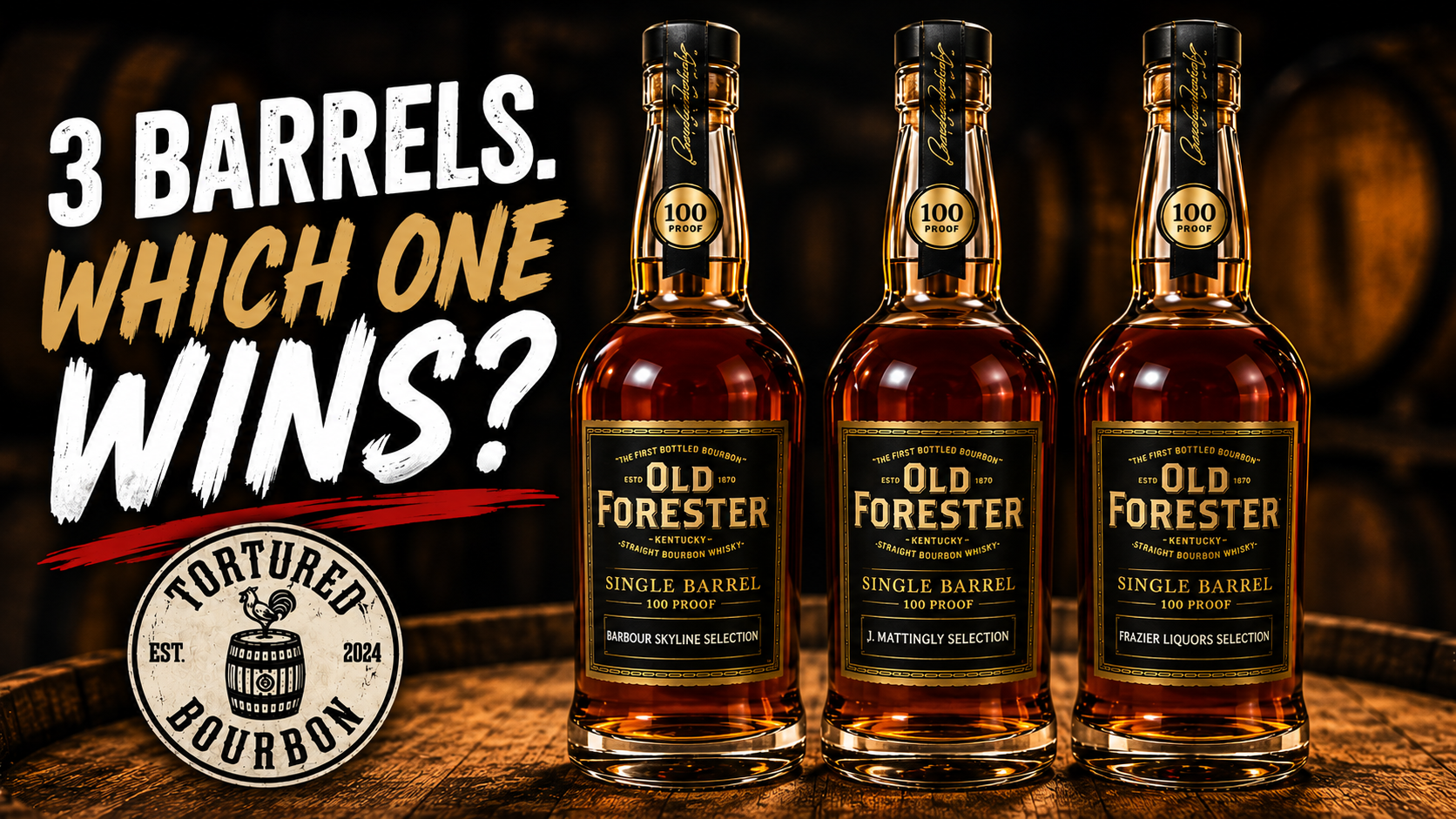
If you’ve spent any time around bourbon enthusiasts, you’ve probably heard someone say, “Every single barrel is different.” But how different can they really be when they’re the same bourbon, bottled at the same proof, by the same distillery?
That’s exactly what we set out to discover on this episode of Tortured Bourbon.
We poured three Old Forester 100 Proof Single Barrel selections side-by-side to see just how much variation exists from barrel to barrel. The labels all look nearly identical. The mash bill is identical. The proof is identical.
The only thing that’s changed is the barrel.
And as you’ll see, that can change everything.
What Makes Old Forester Single Barrel Special?
Unlike many distilleries that offer only a barrel-proof single barrel program, Old Forester offers retailers the opportunity to select 100 Proof Single Barrel expressions as well.
Every bottle comes from one individual barrel, meaning there is no blending to create consistency across batches. Each barrel develops its own personality based on where it matured inside Brown-Forman’s warehouses.
That means every pick can offer something a little different.
Some lean toward rich caramel and chocolate.
Others explode with cherry, baking spices, or oak.
That’s part of what makes hunting Old Forester store picks so much fun.
Does Warehouse Location Really Matter?
One of the most interesting aspects of Old Forester’s single barrel program is the warehouse information printed directly on the bottle.
Our three bottles came from different warehouse floors—6, 7, and 8.
While the warehouse floor isn’t the only factor influencing flavor, it can play a significant role.
Generally speaking:
Higher floors experience greater temperature swings, encouraging whiskey to move in and out of the barrel more aggressively.
Lower floors tend to age more slowly and often develop softer oak influence.
Every warehouse has its own airflow, humidity, and microclimate.
The result?
No two barrels mature exactly alike.
Three Barrels. One Winner.
Rather than relying on tasting notes from the distillery, we wanted these bottles to compete on their own merits.
Each pour was judged on:
Nose
Palate
Mouthfeel
Finish
Overall balance
Drinkability
Because that’s what really matters when you’re deciding which bottle deserves a spot on your shelf.
Is Hunting Store Picks Worth It?
This tasting reinforces something many bourbon fans eventually discover:
Not all single barrels are created equal.
Sometimes a store pick becomes one of the best bottles you’ve had all year.
Sometimes it’s simply good.
That’s both the excitement—and the gamble—of buying single barrel bourbon.
It’s also why trusted retailers and experienced barrel pickers have developed loyal followings.
Our Final Thoughts
Old Forester continues to produce some of the best value bourbon on the market, and their 100 Proof Single Barrel program gives enthusiasts an opportunity to experience just how much influence one barrel can have.
Whether you’re a seasoned collector or just beginning to explore store picks, tasting multiple barrels side-by-side is one of the fastest ways to appreciate why bourbon lovers chase single barrel releases.
If you’ve had an exceptional Old Forester Single Barrel, we’d love to hear about it.
Which warehouse floor has produced your favorite bottle? Let us know in the comments.
Watch the Full Episode
In this episode of Tortured Bourbon, we put three Old Forester 100 Proof Single Barrel selections head-to-head to find out whether one barrel truly stands above the rest.
As always, we’ll rank each bottle using the official Tortured Bourbon scale—from Piddlin’ all the way to Cock of the Walk.
Because we suffer through bourbon so you don’t have to. 🥃
